September 14th, 2013: Never Give Up!

                   One of the many trials of birding is the patience needed to look for a bird. Sometimes you'll be birding at your local patch, and it will be so slow that you won't even be hearing any Black-capped Chickadees. Or you'll be chasing a vagrant for hours and you'll leave without even the slightest glimpse of the sought-after bird. My story here will be talking about the latter. Rather than going through my entire day and listing all the species I saw, I'm going to talk about a brief part of my day of birding. This anecdote will talk about our chase of a staked out Stilt Sandpiper on Port Kenyon Road, in Ferndale, an annual, but scarce, species in Humboldt county.
                  After having participated in Rob Fowler's monthly survey of Shay Park, where we were able to relocate an Ash-throated Flycatcher and a Vesper Sparrow, the former being a good bird for the patch, and the latter being a good bird for the county, Samantha Bacon, an enthusiastic beginner birder, a buddy of mine, Stephen Montano, that also attends Humboldt State University, and I decided we wanted to chase the staked out Stilt Sandpiper. This bird would have been a state lifer for me, and an all-around lifer for my two cronies. Rob and two other birders that participated in the survey decided to join. The more the merrier! We drove down from the town of Arcata to Ferndale, approximately a 30-minute drive. We finally arrived, and made our way to the edge of the slough where the bird had been sighted. There was a remarkable amount of shorebird activity, from the typical peep species, to both species of yellowlegs and the ubiquitous Killdeer. Unfortunately, our dowitcher-emulating species eluded us. We decided to walk down the bank, where every step was a gamble, as the mud rendered the terrain near-impossible to walk on without slipping and either falling on your posterior or falling into the murky water. The best bird that our endeavor yielded was a single Wilson's Snipe, a county lifer for me. But we hadn't driven 30 minutes and risked ruining our optics by falling into the repulsive water to see a snipe. We wanted the Stilt Sandpiper. We spent a good hour and a half walking up and down the bank without sighting our bird. Being realistic, we decided to call it quits and head out.
                    Before returning to Arcata, Rob wanted to stop at a known shorebirding location and see what there was to see. A tad more productive, we came across a Common Murre and a bevy of shorebirds, including my county Snowy Plover. Satisfied with our finds, we finally thought it was time to head on out. Rob's gray 4x4 led the path and we slowly followed it, our excitement and enthusiasm we had prior to our arrival virtually gone. However, as Rob's car made a left at a T-Intersection, Samantha turned right. Puzzled as to why she did that, I asked her what she doing. She then said that she was determined to find the bird, for she was extremely looking forward to this sighting. So we were heading back to the end of Port Kenyon Road, back to the same slough. I unenthusiastically exited the vehicle, because all this place reminded me of was the failed attempt at seeing a fantastic species. I peered through my binoculars at the end of the bank and noticed a cluster of yellowlegs, both Greater and Lesser, but I don't notice anything else. This is when Samantha asked me what she was looking at (she knew it wasn't a regular bird). All of a sudden, my excitement grew ten-fold. I looked through the scope and there it was: our Stilt Sandpiper! It was preening itself, but the longer, decurved bill, and the broad supercilium were still quite evident. It was actually in the middle of the group of yellowlegs I was looking at with my binoculars. We slowly approached the bird, which it didn't seem to notice, and we began digiscoping it. Right afterwards, Rob called me asking where he had gone, and I informed him about the bird. He was back in less than five minutes. We all earned incomparable views as it mingled with the adjacent yellowlegs.
                  This little anecdote just goes to show that patience and persistence are the traits that are needed when birding. Haste and impatience are key to avoid seeing any species. If I had gone chasing that bird on my own, not only would I have missed it the first time, but I wouldn't have bothered returning and trying for it a second time. So thank you Samantha Bacon for your optimism and unwillingness to give up! It earned us a great bird, a great time, and a great life lesson.
Stilt Sandpiper
(notice the long, decurved bill,
and the broad suprcilium)

July 16th, 2013: Parque Nacional de las Bardeñas Reales

              This was the final day of legitimate birding in Europe. This sad realization became my motivation and drive to make the final excursion worth it. I decided that I wanted to bird somewhere in Spain, outside of Zaragoza, known for boasting two species of sandgrouse and bustards. Unfortunately, motivation wasn't quite enough fulfill my yearning. It turned out we didn't know how to get there! Despite having the directions on my phone, we were incapable of figuring out how to get there. We endeavored and kept on searching, but after driving for about 2 hours without any idea if we were approaching or distancing ourselves from the preserve, we decided it was time to head home. I was upset, and I didn't want do anything but mope around for the remainder of the day. But then my dad remembered of this reserve where he used to go biking when he was younger. This was the "Parque Nacional de las Bardeñas Reales". Once we arrived, my enthusiasm started increasing again, and I was ready to bird there.
              Spain is a very arid country, and much of its terrain is actually dry, open steppe. This is exactly what this environment was like: dry and arid, and not to mention hot. As I was admiring this unforgiving terrain, I noticed a long, gray bird perched on a wire. I immediately told my dad to pull over so I can observe it, and thank goodness I did so because this bird ended up being my lifer Southern Gray Shrike. This species was once known as the Iberian Gray Shrike, and rightfully so because its range extends throughout much of the Iberian Peninsula. Although it is also found in parts of southern France, so that name had to be corrected.
Southern Gray Shrike
(notice the long body, the gray head, and the black mask)
               We continued driving and I noticed European Goldfinches and Eurasian Linnets along the side of the road. A European Bee-Eater made an appearance as it hovered around, chasing some flying invertebrates. And best of all, my lifer Corn Bunting flew onto the road, directly in front of the car. The most distinctive field mark on this bird to me was its uniquely shaped bill, although the streaking all along the body was also a tell-tale field mark I paid attention to. 
               As we drove, a large flock of passerines emerged from the ground. I could tell these were all larks. But, they were flying so quickly and so high up, that identifying them was very difficult. On one of the larks, I noticed a black undertail which I learned, after referring to my field guide, was characteristic of a Greater Short-toed Lark, my first lifer. I was able to snag a shot of it when it landed on the ground which shows some of the field marks.
Greater Short-toed Lark
(notice the broad supercilium, and the bare chest)
            Another species of lark in this flock, and more abundant too, was the Calandra Lark, a more widespread and distinctive species. This larger species was easy to pick out of the flock, as it looked remarkably different from the other species. 
Calandra Lark
(notice the orange on the crown and the supercilium)
Calandra Lark
(notice the supercilium, the back pattern,
and the overall chunky appearance)
                The flock flew further off, and decided to continue down the empty road. The heat was sweltering and it became extremely uncomfortable. In the back of my head, I was actually hoping that the auto-tour route was coming to an end, but as I thought this my next lifer flew into view. It was a Black-eared Wheatear, a species I really wanted to see! With its upright posture, it perched elegantly atop a rock. Far from modest, this bird knew it was handsome and was showing it.
Black-eared Wheatear
(notice the black face and wings, and the light beige elsewhere
on the body)
             Another unexpected surprise was a Tawny Pipit that skittered along the side of the road. I hadn't this species since I was in the Camargue National Reserve, so it was a pleasant sight indeed.
Tawny Pipit
(notice the Anthus structure, and the black markings on the face)
                Finally the auto-route ended, and we were homebound. However, just before leaving, I noticed two starlings perched on a wire. Anywhere else in Europe I wouldn't have paid much attention to them, but in Spain there are two species of starlings: the ubiquitous European Starlings, and the sought-after Spotless Starlings. We pulled over, and to my excitement, these birds were indeed Spotless Starlings! My final lifer of the day, I was ecstatic to see this species because this species was part of the reason why I wanted to go out to Spain. Unfortunately, the only shot I was able to take of this species was rather distant and blurry.
Spotless Starlings
(no distinctive field are visible in this photo)
               This concluded my day in Spain, and basically my trip to Europe. I managed to rack up a total  of a little under 150 species, and I got 97 lifers! This was a fantastic trip, and I cannot wait for my next trip to Europe. Any birder visiting Europe should really take advantage of it and bird as much as they can, because you never know what you will find!
Parque Nacional de las Bardeñas Reales

July 11th, 2013: Hartza Mendi

              After having birded Mount Iraty the previous day, I was excited to see what we come up with at a different location but of the same habitat. That day, my dad brought us to a mountain called Hartza Mendi. In Basque, "mendi" means mountain and "hartza" means bear, so this location translates to "Bear Mountain". Unfortunately, we dipped on any Pyrenean Brown Bears, but that was made up for with the great birding.
              As we ascended the road, a raptor caught my eye and I immediately told me dad to pull over. I rightfully did so because this bird that I was about to pass as a Common Buzzard turned out to be my lifer Short-toed Eagle. It had the distinctive brown chest and barred underbelly and underwings. This was exciting, because the end of our trip was nearing and I hadn't seen this species yet. I was under the impression that this species was relatively easy to see, so I was going to be greatly disappointed if I missed it. It didn't stick around, so I wasn't able to snap a shot of it before it soared off. Another fun bird we came across was a perched Red-backed Shrike, a species I hadn't seen since we were in the Petite Camargue in the Alsace.
Red-backed Shrike
(notice the namesake red back, the black mask,
and the gray head)
                   As we observed this superb shrike, a Mistle Thrush flew onto a nearby telephone wire, offering amazing views. We finally made it to the top, and we began walking down the main trail. One of the first birds I noticed on the trail was surprisingly a Tree Pipit, a species I hadn't seen since I was on Mount Pilatus in Switzerland. This bird was quite obliging and offered great views and opportunities to study its field marks: the thick breast stripes and thin stripes on flanks.
Tree Pipit
(notice the thick breast stripes,
and thin flank stripes)
            As we walked, the activity was disappointing and I wanted to head back, but my dad insisted because he knew of a spot further down the trail where you have a fantastic vantage point over soaring vultures. Knowing that I would regret passing up an opportunity like that, I decided to trek on. Thank goodness I did because about 20 feet in front was my lifer European Stonechat, another bird I was worried that I would miss. This bird earns its name "Stone"chat from its distinctive call that sounds like two small pebbles hitting each other.
European Stonechat
(notice the black head and back, the white patch on the shoulders,
and the rufous-orange breast)
                 As we continued walking, we noticed some more species such as Black Redstarts & more Mistle Thrushes. Soon after, we approached the promontory that my dad was talking about, where we could see all the vultures. I hadn't ever seen Eurasian Griffons at such proximity before, so I was really taken aback. It was quite a sight indeed.
  
Eurasian Griffon
(notice the elongated neck, the massive bill,
and the brown back and wings)
Eurasian Griffon
(notice the white underwings,
and the "finger"-like primaries)
                  As we admired these soaring Old World vultures, a Peregrine Falcon quickly zipped by, and landed on a nearby rock. This species had been a nemesis of mine for the longest time, and I hadn't seen one before August of 2012 when I went to Camp Chiricahua. Once I saw that first individual, I began noticing them more often. It was as if I had broken the curse! So I was glad to know that the curse was broken on a global-scale and not just within the ABA region.
Peregrine Falcon
(notice the slaty-gray mantle,
the white underparts, and the yellow cere)
               But my excitement only increased when another falcon decided to chase and nag the falcon perched on the rock. They began racing along the cliffside and dive-bombing each other. I could feel my own adrenaline pumping when I was watching these two raptors in this high-speed pursuit. 
               Unfortunately, these two speed-demons continued their chase on the other side of the cliff walls, out of sight. We thought it would be wise to leave on this note, so we resumed our trek up the fern-bordered trail. We were just about done with the hike, and we were almost at the car, when something yellow flies from the trail into the ferns. I intensively pished, and finally my efforts proved fruitful as I put my binoculars up to a Yellowhammer, a species I hadn't seen since I visited the Black Forest in Germany.
Yellowhammer
(notice the overall yellow and the rufous on the back)
         This concluded our morning on Hartza Mendi, and with two lifers, I would say that it was a good morning.

July 10th, 2013: Mount Iraty and the Pyrenees

               It was nice to be back in my homeland, in the Basque Country, and breathe the fresh mountain air every morning. During my previous trips to Europe, we would always spend all our time in the Basque Country, and visit areas in the vicinity. So it was interesting to begin our trip to Europe in Switzerland and end it in the Basque Country. It was also interesting because this would be the first time I ever go birding in the Basque Country, despite my numerous trips in past, which is why I was very excited when my dad told me he wanted to bring me to this spot where he used to go hiking when he was younger.
               This locale is the Mount Iraty, one of the myriad summits that compose the Pyrenees, connecting the Atlantic Ocean to the Mediterranean Sea. My dad remembers seeing many raptors here when he was younger, so I was optimistic about our day. As we ascended, we could see the small villages in the valley decrease in size. We finally pulled over and seated ourselves in some old, dilapidated hunting blinds, used during open season to hunt migrating pigeons (which fortunately wasn't the case when we were there). The first birds we began noticing when we were in the blinds were a few Eurasian Griffons, the emblematic birds of the Basque Country that have been subjects of the numerous tales in Basque folklore. Although their ranges are somewhat restricted in Europe, they are nonetheless abundant within that range. I remember being a kid in the Basque Country and seeing the sky darkened by the sheer numbers of these soaring raptors. Although there weren't quite as many of these raptors at this time, it was nonetheless exciting to see, as it had been a few years since the last I had seen these birds.
Eurasian Griffon
(notice the broad wings with "fingers" at the tips,
and the white on the underwings)
                 As these vultures flew above us, another raptor flew above us but in the other direction. It was a gorgeous Red Kite, and it offered sublime views, where I was able to see the intricate underwing pattern.
Red Kite
(notice the distinctive angled wings and long, "forked" tail,
the white strip on the primaries and the red tail)
               Aside from the raptors, the blinds didn't yield much of interest. However, as we were heading back to our vehicle, I noticed something zip by quickly. My instinctual thought was "hummingbird", but I realized how preposterous that statement was, right as I thought it. It turned out this was actually a species of sphinx moth, a moth that rapidly beats its wings, and gleans the nectar from flowers thanks to its remarkably long proboscis. It was an exciting find indeed.
Sphinx Moth
             The remainder of our day consisted in driving along the tortuous and meandering road, and stopping whenever we spotted anything. The first bird we stopped for was a Water Pipit, a species I previously saw, for a brief moment, while on Mount Pilatus in Switzerland. My previous views were fleeting, so I was happy to see this pipit perched atop a pole in plain sight, being a cooperative subject, unlike every other bird on that continent.
Water Pipit
(notice the supercilim, and the sharp beak)
Water Pipit
(notice the distinctive face pattern, the dark scapulars,
the faint streaking on the flanks, and the buffy underbelly)
                I hopped out of the car to get better shots of this bird, and as I did so, I noticed the a decently-sized kettle of raptors circling, so I decided to study each bird, to enhance my european raptor identification. They were all Eurasian Griffons and Red Kites, the most expected raptors at this altitude. However, I noticed a thinner and smaller raptor circling with them, further away from the main kettle though. It had a white body with black primaries and secondaries. I suddenly gasped, and realized that this was an Egyptian Vulture, a species that I didn't think I would see at all! Unfortunately, it flew off before I could snap a shot of it, but I was still enchanted but this unexpected sighting.
                We continued driving and we noticed another kettle. After our exciting find, we figured it would be wise to scrutinize this flock as well. Although there weren't any raptors of interest in this area, I noticed a medium-sized passerine hopping along the rocks. It finally perched on top of an open rock, and I was able to identify this bird as a Northern Wheatear. I was worried that I would dip on this species during my time in Europe, so I was greatly relieved when this stunning bird made an appearance. 
Male Northern Wheatear
(notice the black face mask and wings, the gray back,
and the sharp beak)
                I had studied this bird many times in the past (in hopes of perhaps coming across one in the Bay Area), but never truly realized the subtle elegance of this bird. Seeing how clean and crisp this alternate plumaged adult appeared, it made me realize how spectacular this species actually is.
                As the wheatear flew off, we too drove off. We came across a large flock of choughs, so we pulled over to check them out. But as we did so, I saw a white figure slowly drifting in our direction. It was the Egyptian Vulture! It had returned, offering me another chance to photograph it. It flew right above us, and we earned incomparable views that have been indelibly engrained in my memory. It was truly an incredible sight and the photos do not do justice to the magnificence of this bird.
Egyptian Vulture
(notice the yellow head, the white body,
and the black primaries and secondaries)
            To our dismay, this bird didn't stick around, and as soon as it arrived, it vanished. Now that we weren't distracted, we could focus on the massive chough flock. I assumed they were all Yellow-billed Choughs, but when I put my binoculars up, I realized that this massive flock consisted entirely of Red-billed Choughs, another lifer!
Red-billed Choughs
(notice the the all-black bodies and the decurved, red bills)
Flock of Red-billed Choughs
             The flock soon dispersed and I started heading back to the car. But as I do so, some movement in a nearby shrub caught my attention. I looked to find my lifer Dunnock, a species notorious for being difficult to spot due to their surreptitious behavior and cryptic plumage. Also known as the Hedge Sparrow, this species frequents a variety of habitats, but tends to stick with thickets and other shrubs, which explains its presence here up in mountains. Not only that, but it also had a chick with it, peeping stridently.
Dunnock
(notice the brown mantle with darker streaks,
the gray body and the streaks along the flanks)
           This concluded my first day of birding in the Basque Country. Seeing some species typical to alpine climates was very fun, and the lifers sure made this outing that much more special. After a phenomenal first day, I couldn't wait to see what else the Basque Country had in store for me.
The view from the top of Mount Iraty

July 7th & 8th, 2013: Third day in the Camargue National Reserve and the Cirque de Gavarnie

                      The morning of July 7th was the morning of our final day in the Camargue National Reserve. My father and I had basically visited all the best spots of the reserve and we really didn't know where else to go. My dad then proposed we visit the town of Aigues-Mortes in the "Petite Camargue". As we drove through the small city (as it wasn't quite small enough to be called a "town"), I was discouraged because it didn't seem like there would be any suitable habitat to bird there. Then I noticed a large pond with several flamingos on it. I figured that birding this pond, lined with paths frequently used by joggers, dog-walkers and bikers, was better than driving around aimlessly and burning daylight. So we parked and began walking down. There weren't any birds of interest on the pond, just the regular stilts and gulls that abounded elsewhere. Suddenly this small white bird began bouncing over the small and dispersed flocks of the aforementioned. In noticed its black outer primaries and very stubby tail immediately and was able to determine that this was a Little Tern without even putting my binoculars up. This bird was fun because I had only seen it once before. But so far, that was the best bird. This pond was remarkably desolate. However, it wasn't that surprising when the surrounding highway, boisterous passersby and sound pollution were taken into account. As we approached the end of the trail, I was contented to find a few Common Shelducks sitting on a few islands, with their red-knobbed bills tucked into their wings. Suddenly I noticed a large gull movement in the sky above us. I immediately assumed these were some Yellow-legged Gulls, but they looked a little off. Curious as to what they were, I put my binoculars up and found myself looking at about 30 Mediterranean Gulls flying west. I read in my book that gulls and other shorebirds use some nearby ponds as feeding grounds, which must explain this relatively large movement.
One of the many Mediterranean Gulls flying over
                 Then I noticed this smaller, daintier gull flying in the other direction. As I looked at it, the only feature that really stood out was its trailing white edge to its wings, which indicated that this was a Croicocephalus. I then tilted its head into my direction, and utter joy coursed through every vein in my body. It had a white head and a thin, all-black bill. It was my lifer Slender-billed Gull! This is a very localized species and breeder in Europe, and the Camargue National Reserve is one of their strongholds. Unfortunately, I wasn't ever really able to find out where their breeding grounds were, and they aren't reliable anywhere away from their breeding grounds, so I was ecstatic when I found this bird. This was one of my top-targets for my trip, and I was extremely happy to have found one.
                 This gull was the last notable bird I found at this location, so we decided to drive back to location visited the previous day: the marsh along the side of the road near the "Etang de Scamandre".
                Once we arrived there, we found the usual crowd. There were fewer Whiskered Terns there that day, but there were more Gull-billed Terns than the previous day. It was quite amusing to see the plunge into the shallow ponds in this marsh. What several would do is dive headfirst towards the water, but right before hitting the water, they made a 90º switch and grazed the water with their bill, hoping to snatch a small fish. This technique did indeed prove fruitful as several did end up with their quarry.
Gull-billed Tern
(notice the stubby black bill,
and the black tip to the primaries)
                       Another interesting bird to circle over us was a Eurasian Marsh-Harrier, a fairly common bird found throughout the marshlands of this reserve.
Eurasian Marsh-Harrier
(notice the very broad wings and long tail,
 and the pale face and shoulders)
                        As I scanned this area with my scope, I came across a very dark shorebird. At first I was puzzled, but then it faced me and I knew immediately what it is. Part of the reason why I was so confused by this bird is because usually they aren't present the first week of July in this location, not in high numbers anyways. This bird was a Spotted Redshank in alternate plumage, a gorgeous bird and a lifer. This bird was rather far away, so the only way to get identifiable shots was by digiscoping.
Spotted Redshank
(notice the thin black bill with red at the base,
and the overall dark brown plumage)
                          The only other notable bird of that day was a European Roller that I spotted perched atop a lone tree along the side of the road.
European Roller
(notice the brown back,
and the light blue head and underparts)
                      The following day, we were headed towards the Basque Country where we would spend the rest of our time in Europe. However, rather than driving straight there, I proposed we stop at this scenic location that is known to yield some highly sought-after alpine species: the "Cirque de Gavarnie", an amphitheater-like valley in the Pyrenees, that is known for its fantastic skiing in winter and its scenic hikes during the summer. We began walking up, and I was once again discouraged because of the myriad rowdy hikers that had clearly never seen a birder at hard work on his craft. We then noticed a smaller trail aside from the main trail that led to the forest. Though it didn't provide optimal viewing of the sky, which is what I wanted to pay attention to the most, it was nonetheless a thrilling walk, through a pine forest and over waterfalls, that yielded fantastic views of the typically higher-elevation Coal Tit, one the members of the ever-present European Paridaes.
Coal Tit
(notice the the black bib and head, the white cheek,
and grayish-black back with wing bars)
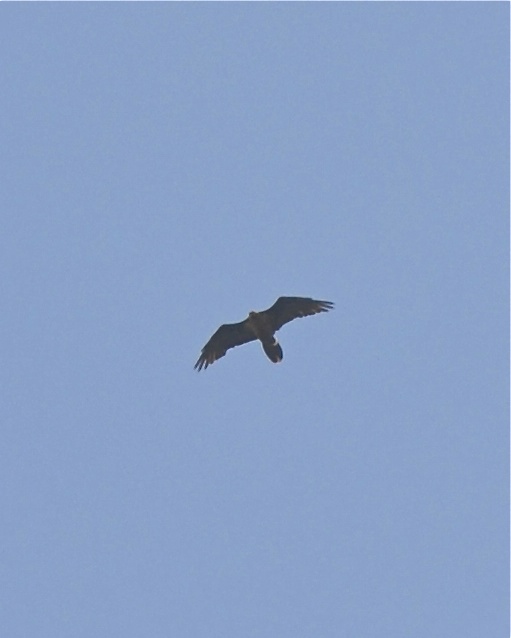
           Aside from the tit, this forest didn't yield very many species. So when we reached the main trail and could see the sky, I rejoiced. Yellow-billed Choughs became obvious, flying in remarkably large flocks and approaching the other hikers and picnickers at amazing proximity, probably in hopes of snagging a quick snack. Suddenly, I noticed this dark figure slowly soar above me. I put my binoculars up, and my heart skipped a beat. I immediately set up my scope at it and got an even better view at this awe-inspiring bird. It was a Lammergeier, every birder's dream sighting. This bird occurs throughout all the mountainous regions in Eurasia, from western Europe, to the Himalayas. However, in all of Europe and northern Africa, there are only an estimated 500 or so pairs that breed there. So this means that the European population is dispersed and sparsely populated, making it a very difficult species to see (which increases the excitement factor). I knew what this bird was immediately when I saw it, they have a very distinctive shape when soaring. The have very long and angled wings, and a very long, broad, wedge-shaped tail. In the right light, the buffy-beige underbelly was noticed, along with the darker shoulder parts on the underwings. Seeing this majestic bird was truly incredible experience that I know I won't be forgetting any time soon.
Lammergeier
(notice the distinctive shape, the long and angled wings,
and the buffy-beige underparts_
                  This concluded my brief visit to the "Cirque de Gavarnie", and despite the briefness, it was enough to really enjoy and appreciate the raw beauty of this pristine environment. There wasn't another place like this Cirque that I birded during my European vacation, so I was happy to make this little detour before heading off to the Basque Country, where I would spend the rest of my vacation.

July 6th, 2013: Second day in the Camargue National Reserve

                 After a well-deserved, good night's sleep, we awoke at the same time as the previous day to head on out early enough to avoid the heat, the crowds and to be able to see the birds fully active. We spent the previous day in the middle and eastern parts of the reserve, so we decided to visit the western part, colloquially called "La Petite Camargue". We drove towards "L'Etang de Scamandre", not surprisingly a vast marsh with designated trails and boardwalks, some leading to some bird blinds. As we drove, we came across a tall tower with a White Stork's nest built at the top. This fascinating structure was at least 4 feet across and 5 feet tall. It was so enormous that there were even little House Sparrows that had built their own nests within that nest, veritable commensalism (one-way symbiosis).
White Stork on nest.
Look at its massive size!
White Stork
(notice the white on its body, the red bill,
and the black primaries)
              Unfortunately, the "Etang de Scamandre" didn't open for another hour. So we kept on driving, hoping to perhaps come across a different marsh we could check out. To our luck, along the side of the road was a marsh that seemed to host many different species. Every 10 meters or so (I was in Europe so it's the metric system), there were gaps in the reeds and they would substitute as blinds. I also sat on the roof of car if I wanted a better vantage point, but I had to do so carefully because the birds were skittish and would flee if they saw me. Anyways, the first bird I noticed was actually one of the best birds of the trip! It was a Little Bittern, a very cryptic and secretive species that isn't seen all that often. Most experiences that birders have with this species either involve hair-tearing, binocular-tossing or just plain rage. This is because this bird is most often heard calling deep in the reeds. Already seeing a brightly colored bird in reeds is difficult, so imagine trying to find a bird with a plumage adapted to render it nearly invisible in this environment. That is this species's best defense, and best offense. It'll use its brown-yellow streaks on its throat and breast to mimic the tall reeds to escape the sight of any possible predator. However, this camouflage also serves as a means of sneaking up onto an unwary fish or invertebrate, that it'll then devour quickly after a quick snap of the neck.
Little Bittern
(notice the brownish streaks on the neck,
and the gray-blue cap)
                This was quite the find and was a great way to kickstart my day! After perusing the marsh thoroughly with my scope, I learned that there were many species to be found, from Black-winged Stilts, to Squacco Herons, to an immobile Purple Heron on the prowl.
Purple Heron
(notice the orange neck with the purple streaks,
and the dark colored wings)
                   Overhead were small flocks of Glossy Ibis. This species was a lifer for me, but I never thought that my lifer Glossy Ibis would be in Europe. This species is found on the eastern side of the United States and the Caribbean. It's thought that this species was originally from the Old World and naturally spread to South America in the 19th century, and from there extended north to North America.
                  As a huge flock of Black-headed Gulls took off, I noticed some smaller terns amongst them. To my great pleasure, these darker colored terns ended up being my lifer Whiskered Terns! This tern belongs to the unofficial complex known as the "marsh-terns", along with other species like the Black Tern and the White-winged Tern.
Whiskered Tern
(notice the gray underbelly, the black cap,
and the white cheek)
                  Finally it was 9:00 AM, so we headed towards the entrance of the "Etang de Scamandre". It was a great little reserve. The trails were well-maintained and well-indicated, it was overall remarkably pristine, and birds were singing from everywhere. Unfortunately, the foliage and the reeds were extremely dense and thick, so it was extremely difficult to see any birds. As we walked towards the blind, the only interesting birds were some flyover Purple and Squacco Herons. We finally arrived at the blind, and we had a view of the entire marsh. Thanks to my scope, I was able to find my lifer Great Reed Warbler. This bird was extremely loud and could be heard from a great distance, but it was crouched deep in a bush while singing, which made it difficult to snap a shot. So I digiscoped it with my trusty iPhone.
Great Reed Warbler
(notice the relatively large beak)
               As I watched this little guy, two large white birds landed on a branch further back in the marsh. These birds ended up being Eurasian Spoonbills, another lifer! These fun birds have a rather bizarre-looking bill, but that goofy bill is extremely utile. The spoon-shaped base helps capture more grasses or invertebrates as it swishes its bill left and right in the water. A peculiar bird, but an undeniably beautiful one at that.
Eurasian Spoonbills
(notice the all-white body,
and the spoon-shaped bill)
                  These birds were quite exciting to see, and my excitement only grew as my lifer Little Grebe paddled out of the reeds into view. This species in breeding plumage is extremely pretty, what with its rufescent and black body, or its yellow-green skin-like gape. It was a stunning little bird to see.
                 Once we left the blind, we were greeted by three small juvenile Bearded Reedlings that were remarkably showy. When these birds reach their adult plumage, they develop these black feathers that extend from their eyes, down their cheeks, to the bottom of their head (which is how they earn their name "Bearded" Reedling). However, as these were juveniles they lacked these mustaches. They were nonetheless pretty and pert little birds.
Juvenile Bearded Reedling
(notice the pattern on its back,
and the dark lores)
                 We continued down the trail and reached an elevated platform, that gave a broader view of the marsh and neighboring fields. In the fields I noticed Western Yellow Wagtails flying from shrub to shrub, Zitting Cisticolas squabbling and a surprise male Reed Bunting! A lifer for me, and the only one I saw on the trip!
Reed Bunting
(notice the black head, the white malar
and nape, and the brown back)
                   Along with the myriad herons and egrets that flew, of every species (Gray, Purple, Squacco, Great, Little & Cattle), there were also many ibis that flew over. It turned out that "l'Etang de Scamandre" is one of the few areas where this species breeds in all of southern France. 
Glossy Ibis
(notice the blue-green face,
and the iridescent green wings)
                   As I was about to descend the platform, a medium-sized bird with white wings bars caught my attention. When I put my binoculars up, I noticed it had an upturned bill. I immediately knew what it was: a Black-tailed Godwit! The only other option would've been a Bar-tailed Godwit, but those are only rare migrants in the area, whereas Black-taileds regularly migrate through and even winter in the region.
                   The trail soon led to a forested area right at the edge of an open pasture. This ecotone (where various habitats meet) boasted many European Goldfinches, Common Nightingales, a European Bee-Eater, and my lifer Melodious Warbler. The trail meandered through this zone until it brought us back to the entrance. Before leaving the reserve, we decided to stop for lunch and eat at one of the picnic tables (as it was 12:30 PM by then). As we were eating I noticed many numbered birds boxes under the eaves of the roofs, and banded House Sparrows would fly in and out of the boxes. This was a funny sight for me because in North America, House Sparrows are an introduced species and are considered a nuisance, so nobody would ever bother studying them. But in Europe, they're a native species, so studying them would make sense. It was somewhat of a culture shock for me. Among the House Sparrows foraging in a nearby tree, I also spotted a single Eurasian Tree Sparrow, my second during the entire trip.
                      Not knowing where to go next, we decided to wander and see if we could come across a field or a marsh worth scoping out. As we drove, I noticed a large field with a large number of Cattle Egrets. Enticed, we pulled over and I scoped it. As far as shorebirds went, this was the place to be. I saw 4-5 Northern Lapwings, about 3 Wood Sandpipers, and over 45 Black-winged Stilts. However, the shorebird that truly blew me away was a European Golden-Plover, a very early arrival! In my guide for birding the Camargue National Reserve, the abundance of the golden-plovers in the month of July is a 0 over 5. This was an exceptional and unexpected find that really made my day.
European Golden-Plover
(notice the black on face and belly,
the white lining, and the gold cap and black)
                  Unfortunately, that's about as far as the birding here went. So we decided to venture further east than we had the previous day. We began arriving in this area that didn't resemble the Camargue that we were used to whatsoever. It was remarkably arid, open and windy. There were very few people, and the birds were nonetheless present. Several Greater Flamingos congregated in the middle of a pond, and a few Yellow-legged Gulls reposed on the ground, incapable of escaping the afternoon heat. The shorebirds were interesting here as well. My dad pulled over, and I rolled down the window to bird from the car. A few feet away from me was a Little Ringed Plover, a lifer for me on this trip (I saw one during our brief stint in Nice), but this was a much better view.
Little Ringed Plover
(notice the yellow eyering,
the white collar and front,
and the brown head and back)
                    Right in front of the plover was an equally exciting shorebird, a Common Sandpiper. Not a lifer, but the best view I've had of this bird to date.
Common Sandpiper
(notice the relatively stout bill,
 the white underbelly,
and the brown-gray head and back)
                    But the most exciting shorebird to see was the Kentish Plover! This species was once lumped with our Snowy Plover, which is understandable when you take a look at both of them. These plovers are more often in open and arid areas. In my experience with Snowy Plovers, they tend to stay away from the direct shore, and will stay in the middle of the beach, away from the water, which was evident when seeing these guys.
Kentish Plover
(notice the overall light colors,
the plover bill, and the dark collar)
                       Once I had viewed all the shorebirds in this area, we kept on driving. We then reached a more touristic area, which was actually a place where salt is cultivated. The Camargue is known for three things: Flamingos, White Horses, and their Salt. My dad decided to buy a jar of salt as a souvenir, so I decided to bird the nearby shrubs, hoping to find something interesting. But as I started walking, I saw a shimmering pink hue in front of me. This piqued my curiosity, and I walked towards it. From a designated promontory, I was looking at these massive pink ponds. The water was literally pink! It was the wildest thing I had ever seen. I learned later that this color is only present during a certain time of year. The water earns this color when the shrimp that reside in these waters die. The combination of the shrimp corpses and the chemicals in the water grant the water with this pink hue. It was extremely fascinating.

                          As I birded the nearby shrubs, I didn't notice any birds. The area was actually devoid of any sort of life. But just as I thought this, I flushed a fairly long bird with white outertail feathers. This indicated that it was most likely a pipit. But there were so many possibilities that I couldn't confidently identify it. After twenty minutes of searching I finally rediscovered it, and to my great pleasure, it was my lifer Tawny Pipit! This is a species that breeds throughout much of Europe, but it sticks primarily to the more arid areas. Seeing how we were in a very arid area, that should've been enough of a clue.
Tawny Pipit
(notice the overall tan-brown color,
and the black lores)
               Just as I was about to leave, another bird catches my eye. However, this wasn't a pipit. From a distance, I was able to tell from its overall structure that it was a Sylvia warbler. Using the same logic that I realized I should've used for the pipit, I was able to deduce that it was actually Spectacled Warbler! A range-restricted species, the Camargue is definitely one of its strongholds. This was definitely a wonderful way to end the day. By then it was 5:00 PM, so we decided to head back home. That concluded our second day in the Camargue National Reserve, and what a day it was. What really made that day special was the diversity of habitats we visited, from the marshes, to flooded fields, to open and arid salt plains. This diversity of habitats yielded a vast diversity of species, which made for a great day of birding!